Showing posts with label Racket. Show all posts

August 11, 2012

Custom Blades with Legal Shapes

We recently went through the different grips used in table tennis - but that post actually doesn't tell the whole truth. The handshake grip, the Chinese penhold grip and the Japanese penhold grip are the most common grips used all over the world. But since the rules allow any shape of the blade and its handle, some people choose more unusual variants or modify and experiment their way to optimized playing. What many people don't know, is that blades no longer need to be approved by any organization before being used in tournaments, as long as they follow the ITTF's racket regulations. You can even change the shape of a retail blade yourself as you wish, or replace the whole handle.

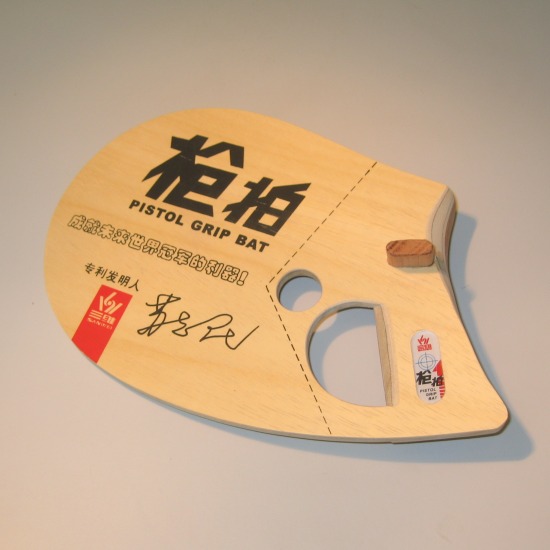
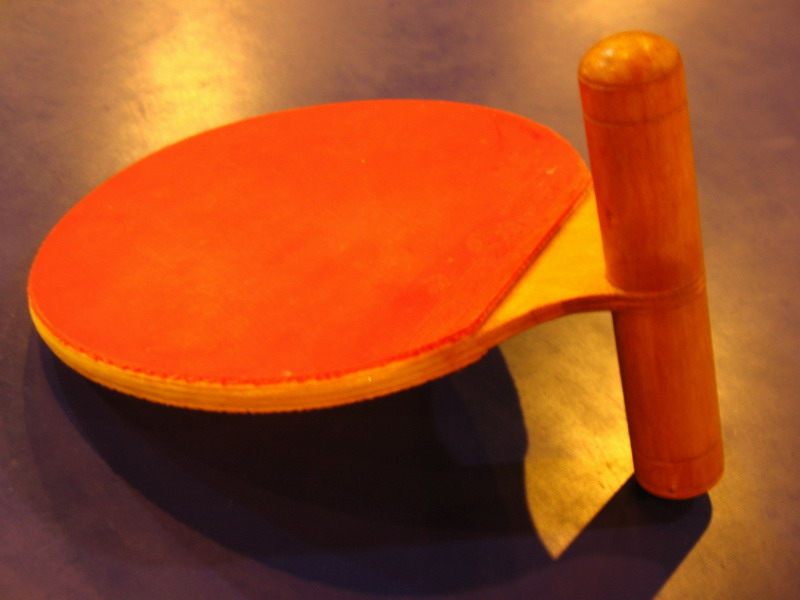
Below, some pictures of modified and custom made blades - all legal to use in professional tournaments (assuming that they contain the right amount of real wood, and so on). But one thing worth knowing, is that it is not allowed to use more than one rubber sheet per side, or to cut it in a way that a referee can't identify it or tell that it's approved by the ITTF.

Blade with wide handleBlade with gun grip (1)

Blade with gun grip (2)Blade with gun grip (3)

Scull bladeCustom C-pen (1)

Custom C-pen (2)Custom C-pen (3)


August 8, 2012

Different Grips in Table Tennis

Most people who have a slight interest for table tennis, have learned that there are two ways to hold the racket. The first is the "handshake" way, and the second is the "penhold" way. The both names are pretty self-explanatory. When using a handshake racket, you grip the whole handle with your hand so the blade is pointing upwards. When using a penhold racket, the blade is pointing downwards and only your thumb and index finger are gripping around the handle, supporting it against the other fingers.

The penhold grip is mostly used by Asian players, while the handshake grip is the most common grip in the rest of the world. This is of course the result of tradition - and it's preserved by manufacturers that focus on only one of the player types. 

Though, there are several big manufacturers that let their customers choose which handle they want on their blade. Stiga has offered six different shapes for many years now, - five different for handshake players and one for the Chinese penholders. And there was a period in the 80's when they offered one unusual type called the Japanese - or Korean - penhold. They only offered it on one of their four different pro blades, and barely promoted it at all in Europe because of extremely low demand. There still are some top-level players who use the Japanese penhold, though. But what is this mysterious "J-Pen"?

Table tennis rackets
1) Handshake 2) C-pen 3) Handshake 4) J-pen
All used in one Olympic game 2012
The shape of the hitting surface on a handshake blade can vary, but usually they look like on the image above. A C-pen can vary a little bit more but are usually very alike a handshake blade. A J-pen leaps out properly, though. It's always significantly longer, and has almost a rectangular hitting area. Often even longer than the rubbers are when they're new and uncut, so there can be some space between rubber and handle on the forehand side where the player can have his fingers.

Practical differences between Handshake, Chinese penhold and Japanese penhold

It might look like the C-pen and the J-pen blades are held the same way, but that's not completely true. A C-pen player typically has the side of his middle finger against the backhand side of his blade, while a J-pen player has the inside of the three fingers against the blade. This brings different advantages and disadvantages.

The biggest difference between using a handshake blade and using an Asian grip blade, is that the Asian blades don't bring any transition between forehand and backhand. That transition makes it difficult for the handshake player to hit shots near the body on the forehand side. The Asian grip player can also hit shoulder-high shots on the forehand with more natural movements while it's easier on the backside for the handshake player. Deep shots on the backhand side is also easier for the handshaker since he doesn't have to twist his arm around and therefore has better reach.

The Japanese penholder has one extra advantage; The blade becomes more of an extension of the arm on the forehand side, which encourages more of a natural swing with high speed and proper spin. But this can be compensated with the length of the blade, which can make it unpractical near or over the table.

Which grip should I use?

Definitely the one that feels the most natural to you. In Europe, the handshake grip is properly established, but in Asia a lot of professional players use it nowadays too. For example 2011 World Champion and 2012 Olympic Champion, Zhang Jike - or defensive player Joo Se-Hyuk, who actually put up a great game against Jike in the team play after the singles final!

Joo Se-Hyuk
Joo Se-Hyuk from South Korea made Zhang Jike work for
the win in the last table tennis game in the 2012 Olympics.
Without the handshake racket, his defensive
play style probably wouldn't work so well.

August 7, 2012

The Racket - Rules and Ways to Exploit Them

Legal racket

As you might have seen in the Olympics lately, the players receive their rackets from the referees before a game starts. This because the rackets are checked for illegal material, substances, and so on.

The following are the regulations that every racket needs to follow (2011/2012)
  1. The racket may be of any size, shape or weight but the blade shall be flat and rigid. 
  2. At least 85% of the blade by thickness shall be of natural wood; an adhesive layer within the blade may be reinforced with fibrous material such as carbon fibre, glass fibre or compressed paper, but shall not be thicker than 7.5% of the total thickness or 0.35mm, whichever is the smaller. 
  3. A side of the blade used for striking the ball shall be covered with either ordinary pimpled rubber, with pimples outwards having a total thickness including adhesive of not more than 2.0mm, or sandwich rubber, with pimples inwards or outwards, having a total thickness including adhesive of not more than 4.0mm. 
  4. Ordinary pimpled rubber is a single layer of non-cellular rubber, natural or synthetic, with pimples evenly distributed over its surface at a density of not less than 10 per cm2 and not more than 30 per cm2. 
  5. Sandwich rubber is a single layer of cellular rubber covered with a single outer layer of ordinary pimpled rubber, the thickness of the pimpled rubber not being more than 2.0mm. 
  6. The covering material shall extend up to but not beyond the limits of the blade, except that the part nearest the handle and gripped by the fingers may be left uncovered or covered with any material.
  7. The blade, any layer within the blade and any layer of covering material or adhesive on a side used for striking the ball shall be continuous and of even thickness. 
  8. The surface of the covering material on a side of the blade, or of a side of the blade if it is left uncovered, shall be matt, bright red on one side and black on the other. 
  9. The racket covering shall be used without any physical, chemical or other treatment. 
  10. Slight deviations from continuity of surface or uniformity of colour due to accidental damage or wear may be allowed provided that they do not significantly change the characteristics of the surface. 
  11. Before the start of a match and whenever he or she changes his or her racket during a match a player shall show his or her opponent and the umpire the racket he or she is about to use and shall allow them to examine it. 
(Source)

Since the rules in table tennis aren't always very strict, there are some things that should be pointed out in this list of regulations.

The material does not necessarily need to be wood

The regulations clearly says that the areas that the ball will never hit can be covered with any material. There is no rule that forbids the user to have whole handles made out of other materials than wood. Another thing that is not mentioned, is that blades made out of cork and bamboo - which is not wood - can be accepted as legal blades. I have also contacted the Swedish table tennis association (SBTF) about this, and they have confirmed that bamboo should be okay while cork is doubtful. Even though cork is tree bark, and bamboo is grass.

Because of these regulations, blade maker American Hinoki has made a blade completely out of cork and bamboo, and calls it the ITTF Rules Protest Blade.

The regulations can be exploited because of lack of precision

Some players who use penhold blades, don't use the backhand side of their blade to hit the ball. But they're still forced by the rules to wear a rubber on each side. Though, there is no rule specifying any minimal amount of rubber, - it just needs to cover the part of the blade where you don't keep your fingers. But a Japanese penholder keeps his fingers over half the blade, - therefore you often see them have one rubber that covers only about half the blade. This means that their blades get significantly lighter than if the rubber covered the whole surface. They can also cut off a little extra weight by making a nice looking curve - as long as all text on the rubber shows (so the referees can identify it as approved material).

Since there is no rule saying that the handles need to be made out of wood, it should be okay using other materials. Most Japanese penhold blades have cork as handle - and since no rule defines what a handle should be shaped like, they often only have the cork on one side of the blade. In the end, Japanese penhold blades can have a very low weight, which brings higher speed.

The rubbers can be a little too big

The rubbers are supposed to reach the edges of the blade, but aren't supposed to stick out further than necessary. Still, you see professionals play with rubbers sticking out several millimeters. (Maybe enough to save a ball every now and then?) Referees have never seemed to mind this, so it can be utilized. To make it less noticeable, edge tape can be used.

Conclusion

Experiment! Use the loopholes to find the best possible assembly for you. Until the ITTF gets more specific!

Inspected rackets